
At a Glance
-
-
- AI-generated contract drafts can capture a company’s intentions and reduce back-and-forth with counsel.
- Professional-looking AI contracts don’t establish whether the documents protect the business or work together.
- Time spent drafting with AI may save legal fees. Meaningful attorney review still requires fact-finding, legal judgment and decisions about risk.
-
A business owner recently approached our firm after spending weeks drafting eight legal documents with AI. After rounds of revisions, the owner wasn’t looking to start over. The request was straightforward. Review what’s already written.
It’s an increasingly familiar conversation. Founders, business owners and executives are using ChatGPT or Claude to prepare customer agreements, operating agreements, privacy policies and platform terms. They spend weeks, sometimes months, revising the language. By the time counsel sees the documents, they look finished.
Why pay for repeated rounds of drafting when you’ve already put your intentions onto paper? Paying a lawyer to revisit those documents can feel like paying twice.
That effort has value. It can clarify commercial priorities, reveal questions and give counsel a better understanding of what the business wants. We’re comfortable reviewing AI-generated first drafts. We don’t believe a lawyer must start every contract from a blank page.
But AI can draft a contract without establishing that the underlying legal and business decisions are right. Getting your intentions into a document doesn’t tell you whether the document accomplishes them.
That’s the challenge with AI contract drafting and review, and why weeks spent generating and revising documents don’t always translate into substantially lower legal fees.
Can ChatGPT or Claude draft and review contracts?
Yes, to a point. Both can generate contract language, summarize provisions and compare versions. That may help get a first draft on the table. But even a carefully revised draft is only a starting point for evaluating whether the contract works.
Drafting and legal review aren’t interchangeable. AI can explain the words on a page, on a high level. It doesn’t know whether those words reflect the deal you negotiated, the way your company actually operates or the law that applies. It may give a confident answer even when important facts are missing.
Consider a customer agreement that says a company will protect all customer data using a particular security standard. The language may read beautifully. But can the company actually meet that promise? Does the vendor supporting the service meet it? What happens if the company can’t? Better wording can’t answer those factual, operational and legal questions.
Where a professional-looking AI contract can fall short
When we review a contract, we do more than check whether the clauses sound reasonable. We look at the connected layers.
We start with the language. What rights and obligations do the words actually create? Are key definitions, exceptions and remedies clear?
Next comes the business deal. Do the documents reflect the economics, leverage and commitments the parties intended? Has anyone decided what the company is willing to concede?
Then we look at operations. Can the business deliver what it promises? Payment flows, service levels, refunds, data handling and customer onboarding all matter.
After that, we check applicable law. Are any disclosures, restrictions or protections required for this transaction, industry or jurisdiction?
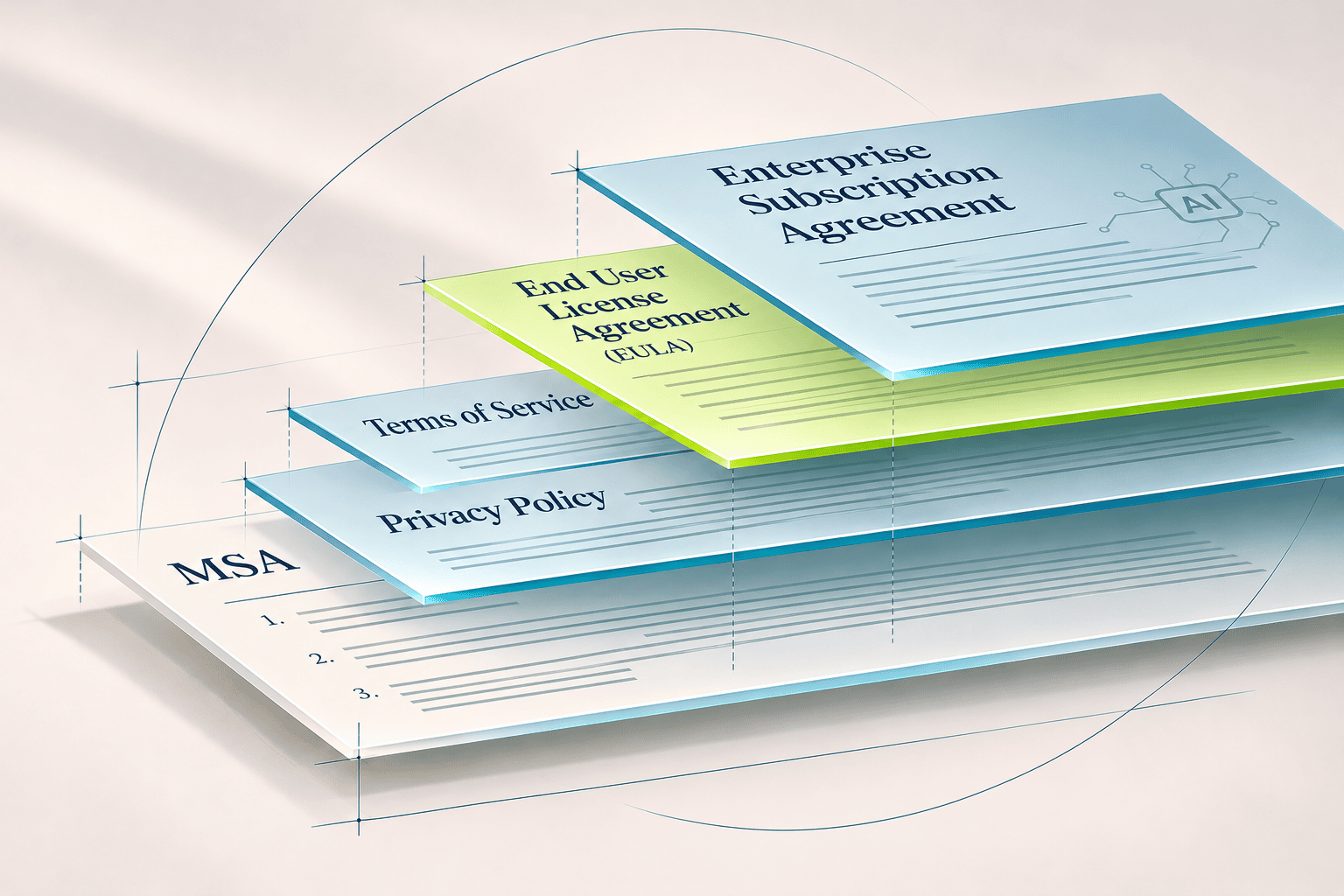
Then we look at the documents as a system. Do the master agreement, order form, statement of work, privacy policy and related documents agree on the issues that matter? Which one controls if they conflict?
AI-generated language can look strong at the first layer while the other four remain unresolved. That’s often where the expensive problems begin.
Where AI-drafted contracts tend to create hidden risk
A clause settles a question no one actually decided. A draft needs to say who owns deliverables, when a customer can terminate or who bears the loss after a service failure. If the business hasn’t chosen a position, AI may still supply a complete-looking clause. The wording appears deliberate even though the decision wasn’t.
The missing provision is hard to spot. A twenty-page agreement can contain extensive indemnity language. It can still fail to address a critical right to transition assistance when the contract ends, a required disclosure or a limitation on data use. It’s easier to notice an awkward sentence than a protection that never appeared.
Related documents contradict each other. Imagine a subscription agreement that limits refunds while the website terms promise broader cancellation rights. Or a vendor contract that permits data use for model training while a customer agreement restricts it. Each document may read well in isolation. Together, they create a problem.
The privacy policy promises more than the product delivers. The Federal Trade Commission’s guidance is direct. It says, “Honor your privacy promises.” Businesses risk liability when stated privacy practices don’t match reality.
The terms don’t match the customer experience. Polished Terms of Use don’t bind customers on their own. Their presentation at signup or checkout matters. In Berman v. Freedom Financial Network, the Ninth Circuit rejected an attempt to enforce online terms. The users lacked sufficiently clear notice and didn’t unambiguously agree to them. Rewriting the clause won’t cure a flawed acceptance process.
These issues overlap. A change to refunds may affect customer terms, provider agreements and the checkout process.
What we find when we review AI-drafted contracts side by side
We often see the same set of documents. A purchase order points to a vendor’s EULA. A custom subscription agreement sits beside it. A DPA and a privacy policy cover the data terms.
Each one reads fine alone. Read together with, for example, the vendor’s own terms or the product’s real data flows, they tell a different story.
Why weeks of AI drafting may not translate into lower legal fees
You’ve spent six weeks refining your agreements with AI. You’ve answered questions, rewritten provisions and considered issues you might otherwise have overlooked. Surely that should save legal fees?
It may. And when it does, you should benefit. A sound first draft that clearly reflects the business deal can save drafting and intake time, especially for one straightforward agreement. But the amount of legal work remaining depends on the transaction and the quality of the decisions behind the draft. It doesn’t depend only on the hours spent producing it.
An experienced attorney often begins with a tested form whose structure, definitions and fallback positions are familiar. An AI draft doesn’t necessarily have that history. Counsel may need to investigate where each provision came from. Some come from reliable sources. Some reflect actual instructions. Others were generated to fill a gap. That can mean examining nearly every clause, including the ones that look perfectly ordinary.
A lawyer’s work isn’t primarily drafting. It’s understanding the deal, testing assumptions, identifying risks and recommending what the business should do. Sometimes the AI draft makes that work easier. Sometimes it reveals how much still needs to be decided.
Courts and the ABA distinguish AI efficiency from legal responsibility
In Flux Drive v. Sparks, the Tenth Circuit considered a claim that lawyers should have billed fewer hours because they used AI and online research tools. The October 30, 2026 decision recognized that technology may reduce hours. It found no evidence of unreasonable billing. Counsel still had to verify legal authorities. The case concerned litigation fees, not contracts. The principle still applies.
The American Bar Association’s Formal Opinion 512 on generative AI takes a similarly measured approach. Lawyers may use it. They’re still responsible for competent representation, confidentiality, supervision and reasonable fees. Efficiency counts. So does accountability.
That’s the standard businesses should expect. Use the technology but check what it produces.
When should a lawyer review an AI-drafted contract?
Skip the page count. Ask what can happen if the document gets something wrong.
Legal review becomes particularly important when an agreement changes ownership or control. It also matters when an agreement assigns intellectual property, governs a material customer or supplier relationship or makes data privacy promises. The stakes rise again when an agreement imposes substantial liability or operates across multiple states an jurisdictions. That’s typically any tech platform and tool.
The same is true when several documents need to function together. A platform’s terms, privacy policy, vendor contracts and refund rules may form one legal framework even if they weren’t drafted together.
For a short, low-risk agreement, a limited review may make sense. Documents tied to a launch, financing, enterprise deal or regulated product are different. A narrow check for errors may not address the actual exposure.
What should a meaningful attorney review of your AI contract drafts deliver?
A useful review should give the business more than a document full of comments. It should separate material risks from negotiable points, identify gaps and recommend practical positions. An attorney should be able to say which issues deserve attention now and which don’t.
Before comparing fees, ask three questions. Will counsel understand how your business actually works? Will the documents be checked against one another? Will you receive an issue list, targeted redlines or coordinated revisions?
A focused assessment, targeted redlines and a full review are different engagements. A limited review can make sense if everyone understands its limits. The risk is believing that a narrow review means every document has been fully assessed and signed off on.
AI can make contract language look finished long before the legal decisions are finished. The weeks you spent drafting still count.
Have AI-generated contract drafts ready for review? Reach out to Gouchev Law to see if our Commercial Contracts review team can help.
This article is for general informational purposes and doesn’t constitute legal advice or create an attorney-client relationship.
Frequently asked questions
Can an AI-generated contract be legally binding?
Yes. If the requirements for a valid agreement are met, a contract may be binding regardless of how the language was drafted. A binding contract isn’t necessarily balanced, complete or favorable to your company.
Can ChatGPT or Claude replace a contract lawyer?
No. They can generate and analyze text. They can’t independently confirm every relevant fact, choose your company’s risk tolerance or take professional responsibility for the legal advice. That matters most for consequential agreements.
Should an AI-drafted contract cost less to review?
It might. A reliable draft of one straightforward agreement can save time. A collection of interconnected agreements may require an extensive review, particularly if the draft rests on assumptions nobody verified. The complexity of the transaction matters more than the appearance of the document.
Can a lawyer simply sign off on an AI-generated document?
Not responsibly. A lawyer can agree to a defined review. A responsible opinion depends on the facts, intended use, governing law and scope of the engagement. A quick approval of an entire document set without that work would create false comfort.
About the Author

Jana Gouchev is recognized as one of the leading corporate lawyers in the country. Jana is a frequent speaker and commentator on business law, and recently ranked by Chambers 2026 New York. She’s a strategic partner for SaaS, AI, and tech-driven businesses looking to scale, secure enterprise deals, and stay ahead of evolving regulations.
Ready to make bold moves? LET’S TALK.
More Resources For You
A vendor’s right to “improve its services” may permit far more than routine product maintenance. These 10 AI training data contract terms help companies protect customer data, privacy, intellectual property, and the value their data creates.
AI is already embedded across the healthcare technology stack. Here’s what health tech companies should know about HIPAA, business associate agreements, model training, de-identification, security, AI agents, and health data that falls outside HIPAA.
Mobley v. Workday shows why AI vendors may face claims directly even as contracts push much of the financial risk back to customers. For in-house legal teams, the key question is whether liability follows the party that actually controls the risk.